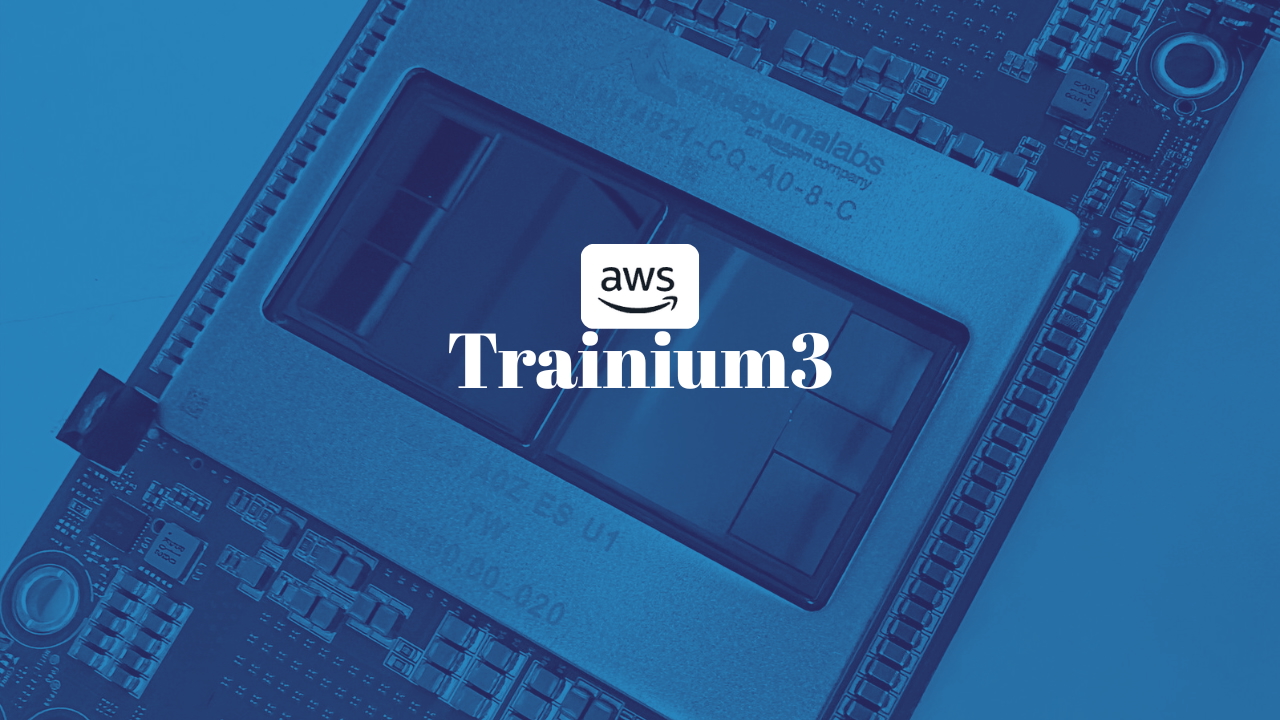
AWS Unveils Trainium 3 Chip Amid Push for Cost-Efficient AI Training
Amazon Web Services (AWS) announced on December 2, 2025, the launch of its third-generation Trainium 3 AI accelerator chip, designed to offer faster training for large language models at reduced costs compared to competitors. The chip, part of AWS's broader strategy to challenge market leaders in AI hardware, delivers 4.4 times the computing performance of its predecessor, Trainium 2, while being 40% more energy efficient and enabling up to 50% lower training expenses for AI models. This development stems from AWS's Annapurna Labs, acquired in 2015, and integrates into "UltraServers" and "UltraClusters" for scalable AI infrastructure, supporting up to one million chips in data centers. The announcement coincides with AWS's deeper collaboration with Nvidia, including access to Nvidia's Blackwell GPUs, reflecting a dual-track approach: custom silicon for cost optimization and partnerships for high-end performance. Availability begins immediately for select customers, with broader rollout planned through 2026, amid AWS's $11 billion investment in data centers like Project Rainier in Indiana.
Timeline of AWS Trainium Chip Operations
AWS's Trainium series originated from the 2015 acquisition of Annapurna Labs, which laid the groundwork for custom AI silicon to address rising compute demands in cloud services. The first-generation Trainium 1, announced in December 2020 and entering general availability in 2022, powers Amazon EC2 Trn1 instances with up to 50% cost savings for machine learning workloads, featuring 800 Gbps networking and 512 GB high-bandwidth memory. Trainium 2 followed in late 2023, with gradual rollout through 2024 on EC2 Trn2 instances, offering improved performance but facing adoption challenges due to ecosystem limitations and subpar benchmarks compared to rivals, leading to quick succession by Trainium 3. Trainium 3, revealed in December 2025, marks a significant upgrade, with initial deployments in AWS UltraClusters and partnerships like Anthropic's multi-gigawatt expansion, targeting full operational scale by 2026-2027. This progression reflects AWS's iterative approach, starting from conceptual design in the late 2010s to production-grade hardware amid escalating AI demands.
Comparison with Google TPU Timeline and Performance
Google's Tensor Processing Units (TPUs) predate Trainium, with the first-generation TPU v1 introduced in 2016 for internal use, achieving up to 92 teraFLOPS in matrix operations and powering services like Google Search. Subsequent iterations include TPU v2 (2017, 180 teraFLOPS), v3 (2018, 420 teraFLOPS), v4 (2021, 275 petaFLOPS per pod), v5e (2023, 197 teraFLOPS per chip with 32 GB HBM), and the latest Ironwood TPU v7 (2025, up to 4.9 petaFLOPS per chip). Google's timeline emphasizes rapid scaling, with pods interconnecting thousands of chips for exaFLOPS-level performance, and a focus on energy efficiency (e.g., v5e at 1200 GB/s memory bandwidth).
In performance, Trainium 3 claims 4.4x compute gains over Trainium 2, with 30-40% better price-performance than alternatives, Per-chip specifications include 2.52 petaFLOPs of FP8 compute, 144 GB of HBM3e memory, and 4.9 TB/s memory bandwidth, enabling dense and expert-parallel tasks with support for mixed-precision formats like MXFP8 and MXFP4, contrasting Google's specs (e.g., TPU v5e at 275 teraFLOPS BF16).
Cost-wise, Trainium instances offer 50-70% savings per billion tokens compared to TPU v5e, though TPU pods excel in large-scale training with superior ecosystem maturity and scarcity advantages. Google's earlier start (2016 vs. AWS's 2020) provides a software lead, but AWS emphasizes integration with its cloud ecosystem for broader accessibility.
Implications for Nvidia Chips
Trainium 3 intensifies competition in the AI chip market, where Nvidia holds over 78-92% dominance in data center GPUs, potentially eroding its position by offering 30-50% lower costs and 40% better energy efficiency for training tasks. This could pressure Nvidia's pricing, especially for H100 and upcoming Blackwell series, as AWS clients like Anthropic opt for Trainium clusters, signaling a shift toward custom ASICs for hyperscale workloads. However, Nvidia's ecosystem advantages, including CUDA software and broader adoption, may limit immediate impacts, with AWS's simultaneous Nvidia partnership mitigating direct rivalry. Long-term, Trainium's growth could diversify the $1 trillion AI semiconductor market, encouraging alternatives amid supply constraints and geopolitical tensions.
AWS Trainium 3 Benchmarks: Key Performance Metrics and Comparisons
Amazon Web Services (AWS) unveiled its third-generation Trainium 3 AI accelerator on December 2, 2025, claiming significant advancements in compute power, energy efficiency, and cost reductions for training and inference of large language models. The chip, integrated into UltraServers and UltraClusters, targets enterprise AI workloads with up to 4.4 times the compute performance of Trainium 2, 3.9 times the memory bandwidth, and over four times the energy efficiency. Per-chip specifications include 2.52 petaFLOPs of FP8 compute, 144 GB of HBM3e memory, and 4.9 TB/s memory bandwidth, enabling dense and expert-parallel tasks with support for mixed-precision formats like MXFP8 and MXFP4.
In aggregate configurations, an UltraServer with up to 144 chips delivers 362 FP8 petaFLOPs, 20.7 TB of HBM3e memory, and 706 TB/s bandwidth, scaling to one million chips in UltraClusters for exascale AI training. Testing with OpenAI's GPT-OSS model showed three times higher throughput per chip and four times faster response times compared to Trainium 2, alongside four times lower latency. On Amazon Bedrock, Trainium 3 provides up to three times faster performance and three times better power efficiency than Trainium 2 or other accelerators, with over five times higher output tokens per megawatt in large-scale serving scenarios.
Relative to competitors, AWS reports up to 50% lower training and inference costs, with customer examples like Decart achieving four times faster real-time generative video inference at half the expense of GPU-based alternatives. No independent third-party benchmarks were detailed in the announcements, and direct comparisons to Nvidia GPUs or Google TPUs focus on price-performance rather than raw metrics. The chip's NeuronSwitch-v1 networking reduces inter-chip communication to under 10 microseconds, supporting agentic, reasoning, and multimodal applications.
Comparison of AWS Trainium 3 and Nvidia H100 AI Accelerators
As of December 3, 2025, AWS's newly announced Trainium 3 chip aims to provide cost-effective alternatives for AI training and inference, emphasizing efficiency over raw power. Direct head-to-head benchmarks are limited due to Trainium 3's recent launch, but available data from AWS announcements and third-party analyses highlight key differences in specs, performance, and economics compared to Nvidia's established H100 GPU. The following table summarizes verified metrics, noting that Trainium 3 focuses on custom ASIC design for cloud workloads, while H100 offers versatile GPU capabilities with a mature ecosystem.
| Category | AWS Trainium 3 (Per Chip) | Nvidia H100 SXM (Per GPU) | Notes/Comparisons |
|---|---|---|---|
| Compute Performance | 2.52 PFLOPs (FP8) | 3.958 PFLOPs (FP8 Tensor Core) | H100 edges out in raw FP8 compute; Trainium 3 claims 4.4x improvement over Trainium 2, but no direct vs. H100 FLOPs benchmark available. Early tests show Trainium 3 with 3x higher throughput per chip for GPT-like models. |
| Memory Size | 144 GB HBM3e | 80 GB HBM3 | Trainium 3 offers 80% more memory, aiding larger models; H100 variants like H200 reach 141 GB. |
| Memory Bandwidth | 4.9 TB/s | 3.35 TB/s | Trainium 3 provides ~46% higher bandwidth, supporting faster data access for training; 3.9x vs. Trainium 2 aggregate. |
| Power Consumption (TDP) | Not specified (focus on efficiency; ~40% better than prior gen) | Up to 700W (configurable) | Trainium 3 emphasizes 4x greater energy efficiency vs. Trainium 2; claims up to 5x higher output tokens per megawatt in serving scenarios vs. alternatives. |
| Training Benchmarks | 3x higher throughput per chip (GPT-OSS testing); cuts training time from months to weeks | Up to 4x faster training for GPT-3 175B with FP8 (vs. prior gen) | No independent direct comparison; AWS claims 4.4x faster overall vs. Trainium 2, implying competitive edge in cost-optimized setups; H100 excels in MLPerf benchmarks for raw speed. |
| Inference Benchmarks | 4x faster real-time generative video (e.g., Decart case); 4x lower latency vs. Trainium 2 | Up to 30x higher on Megatron 530B (chatbot inference) | Trainium 3 halves cost vs. GPUs for inference; H100 leads in high-throughput scenarios with Tensor Cores. |
| Cost Savings | Up to 50% lower training/inference costs vs. alternatives (GPUs implied) | Baseline for comparisons; higher upfront but ecosystem maturity reduces total ownership cost | Trainium 3 positioned as 30-50% cheaper than Nvidia equivalents; e.g., 50% savings per billion tokens in some workloads. |
| Scalability | Up to 1 million chips in UltraClusters; 706 TB/s bandwidth in UltraServer | Up to 8 GPUs in HGX systems; NVLink 900 GB/s interconnect | Trainium 3 optimized for hyperscale cloud; H100 supports MIG for multi-tenancy (up to 7 instances). |
| Process Node | 3nm | 5nm (TSMC) | Trainium 3's advanced node aids efficiency; H100's maturity provides proven reliability. |
Sources indicate Trainium 3 excels in cost and efficiency for AWS-integrated workloads, while H100 maintains advantages in raw performance and software ecosystem. Independent benchmarks are pending as Trainium 3 rolls out.
Comparison of AWS Trainium 3 and Google's TPU v5p
| Category | AWS Trainium 3 (Per Chip) | Google TPU v5p (Per Chip) | Notes/Comparisons |
|---|---|---|---|
| Compute Performance | 2.52 PFLOPs (FP8) | 0.918 PFLOPs (FP8/INT8 sparse); 0.459 PFLOPs (BF16 dense) | Trainium 3 leads in FP8 compute by ~2.7x; TPU v5p optimized for BF16 with sparse acceleration up to 2x. No direct FP8 benchmark for v5p, but inferred from sparse INT8 equivalents. |
| Memory Size | 144 GB HBM3e | 95 GB HBM2e | Trainium 3 provides ~51% more memory; supports larger models without sharding. |
| Memory Bandwidth | 4.9 TB/s | 2.765 TB/s | Trainium 3 offers ~77% higher bandwidth; 3.9x vs. its prior gen. |
| Power Consumption (TDP) | Not specified (claims 40% better efficiency than prior gen) | ~600-700W (estimated per chip) | Trainium 3 emphasizes over 4x energy efficiency vs. Trainium 2; TPU v5p focuses on pod-level efficiency. |
| Training Benchmarks | 3x higher throughput per chip (GPT-OSS); 4.4x overall vs. Trainium 2 | Up to 2x faster than TPU v4 for large models (e.g., PaLM); pod-level scaling to 8960 chips | No independent direct comparison; Trainium 3 cuts training time significantly; TPU v5p excels in MLPerf for dense matrix operations. |
| Inference Benchmarks | 4x faster real-time generative video; 4x lower latency vs. Trainium 2 | High throughput for serving (e.g., 2x vs. v4 in sparse ops); optimized for recommendation systems | Trainium 3 claims halved costs; TPU v5p leads in sparse inference efficiency. |
| Cost Savings | Up to 50% lower training/inference costs vs. alternatives; 30-40% better price-performance | 50-70% lower cost per billion tokens vs. GPUs; competitive with Trainium in some analyses | Both offer significant savings over GPUs; TPU v5p noted for 50-70% lower costs in training large models. |
| Scalability | Up to 1 million chips in UltraClusters; 706 TB/s bandwidth in UltraServer | Up to 8960 chips per pod; 3D torus interconnect at 4.8 Tbps per chip | Trainium 3 supports hyperscale; TPU v5p's pod design enables multislice up to 18,432 chips. |
| Process Node | 3nm | 5nm (TSMC) | Trainium 3's advanced node enhances efficiency; TPU v5p's maturity aids reliability. |